Most BI projects build the wrong thing beautifully.
DECIDE fixes that. Six steps, in sequence, starting with the decisions that matter, not the data you happen to have.

Why most analytics investments don’t pay off.
Organizations invest heavily in data infrastructure, BI tools, and analytics teams. The dashboards run. The reports arrive. And most of the time, the CFO is still making the most important calls of the week on gut feel.
This is not a technology problem. It is not a data quality problem. It is a structural problem with two distinct causes.
01 | The Implementation Gap
Most BI projects are too slow, too expensive, and too complex for mid-sized companies. The reports that exist were built for questions that mattered months or years ago. The data products decision-makers actually need don’t exist, or take so long to build that the decision window has already closed.
02 | The Human Hurdle
Even when analytics solutions are technically sound, they fail to change behavior. People look at dashboards but don’t understand what matters. They see the data but can’t extract the insight. They have the insight but don’t know what decision it implies. At each step, value leaks out of the system.
Both failure modes must be solved together. That is what DECIDE is designed to do.
What DECIDE is.
DECIDE is a decision intelligence framework, a six-step framework for turning data into decisions, and embedding those decisions into the day-to-day running of your business.
It is not a BI methodology. It is not a dashboard design system. It is not a technology framework. DECIDE operates one level above tools. It governs why and how data, analytics, and AI are used, not which tools are chosen.
Traditional analytics logic
The DECIDE logic
This inversion is not cosmetic. It changes everything: what gets built, who it gets built for, what questions it answers, and whether it actually gets used. The sequence matters. Each step builds on the previous one.

Discover

Engage

Clarify

Illustrate

Develop

Embed
Six steps. In sequence.
Discover
Identify where better intelligence will create the most business impact.
Most organizations start BI projects with tools: which tool should we use? What data do we have? DECIDE starts with value. Where are the decisions that matter most to this business right now? Which improvements will actually move the needle? Which questions, if answered, would change what leadership does?
Find the highest-impact opportunities before you build anything. This is where the ROI of the entire initiative is determined, before a single dashboard is designed.


Engage
Understand the real people, roles, and situations where decisions happen.
Data products – reports, dashboards, data stories, chatbots, agents – are tools. Tools are used by people. That is why DECIDE engages the people who will use them from the very beginning, not at the end, when the product is already built.
Who makes which decisions? In what situations? With what constraints? What does their Monday morning actually look like? Build for actual humans in real decision situations, not for theoretical users in a requirements document.
Clarify
Translate human understanding into precise decision questions, information needs, and signals.
Companies almost never define their decisions clearly, and that ambiguity cascades into wasted effort. A team can spend six months building a dashboard that technically works but doesn’t support any actual decision, because nobody ever wrote down what decision it was supposed to support.
Clarify asks: what exactly are we trying to decide? What information would change that decision? What signals are we looking for, the leading indicators that tell us something is about to happen while there is still time to act?
This step creates the decision blueprint that guides everything that follows. Without it, development is guesswork.

Illustrate
Design the decision story before writing a line of code.
Before any data model is built, before any pipeline is designed, DECIDE requires a prototype of the answer. Wireframes, mockups, and narrative structures that everyone can see, critique, and align on.
This is not a cosmetic step. It bridges the gap between conceptual clarity and the technical build. It is where the business stakeholder and the BI team look at the same thing and either agree, or discover the misalignment before it costs six months of rework.
Develop
Build the data models, pipelines, dashboards, BI chatbots, and AI agents.
This is where technology enters the process. Not at the beginning, but here, at step five, after the decisions are defined, the users are understood, the questions are precise, and the solution is designed and agreed.
With clear requirements from the earlier steps, development is dramatically faster and more accurate. There is no ambiguity about what to build, because every decision about what to build was already made. The result: better solutions in less time, with fewer revisions.


Embed
Integrate intelligence into meetings, workflows, decisions, and daily behavior.
Even the best dashboards fail if they are not embedded into daily routines. This is the failure mode that kills the most technically impressive BI projects, which are delivered on time, built correctly, and never opened again after the launch meeting.
Embed makes intelligence the organization’s operating habit, not just another tool people ignore. It defines which meetings this data product belongs in, which decisions it informs on what cadence, and how the organization learns and adapts over time.
This is where the investment pays off. Not at launch. At month six, when the data is still being used, the decisions are still improving, and the organization has built a new capability it didn’t have before
Why the sequence matters.
Most BI projects skip steps 1 through 4 and go straight to step 5, Develop. They start building immediately, with vague requirements, theoretical users, and no decision blueprint.
The result: six months later, they have dashboards that technically work, that nobody uses, because nobody defined what decision those dashboards were supposed to support.
DECIDE forces the thinking before the building. And the embedding after.
The sequence is not a suggestion. It is the framework. Skip a step and the problems of the skipped step appear anyway, later, more expensively, and harder to fix.
Where to Start.
Most executives who read this recognise the pattern immediately. The question is always the same: where do we start, and with what?
That depends on your situation. Some companies need to see what is hiding in their data before they can decide anything else. Others need a clear strategic roadmap before they build. A few are ready to move directly into implementation.
A Gameplan Session is how we find out which one applies to you.
A Gameplan Session is 30 minutes
with me directly.
You describe where your business stands – your data, your reporting, where you feel stuck. I ask focused questions about your business, not your technology. At the end of the conversation, you have a clear picture of where to start and what the right path forward looks like for your specific situation.
It is free. And it is the fastest way to find out whether there is untapped profit in your data – and what it would take to get to it.
— the DECIDE book
The complete framework is in the book.
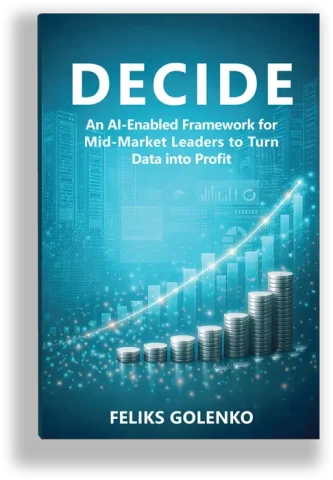
DECIDE: An AI-Enabled Framework for Mid-Market Leaders to Turn Data into Profit is the full treatment – Parts 1, 2, and 3. The case for change, the four layers of AI-driven Decision Intelligence, and the six-step framework in full detail.
Written for executives of mid-sized companies. A complete system for leaders who want to close the gap between data and decisions.
Start with Chapter 1 for free.

— THE AI REALITY
DECIDE in the AI era.
What Changed
AI has changed what is possible in Business Intelligence. What used to cost EUR 500.000 and eighteen months now costs a fraction and takes weeks. What previously required armies of specialists can now be done by one or two people with a solid command of AI tools.
What Didn’t
But AI does not solve the fundamental problem. Without a decision-first framework, AI amplifies noise as easily as it amplifies insight. It builds faster, but if the requirements are wrong, you get the wrong thing faster.
Where DECIDE Fits
DECIDE provides the structural discipline that makes AI useful. Steps 1 through 4 – Discover, Engage, Clarify, Illustrate – ensure that when AI-powered development begins in step 5, it builds the right thing. Step 6 ensures that what AI builds gets used.
The Real Advantage
The organizations building a sustainable advantage right now are not the ones with the most sophisticated AI. They are the ones with the clearest decisions and the right system for turning those decisions into intelligence.